

Understand the core "battle mode" of Chicken Road, how your multiplier builds, and how to survive longer without chasing losses.
Chicken Road isn't just a quirky slot; its bonus round is a self-contained, high-stakes "battle mode" that defines the entire game's appeal and risk. This guide cuts through the cartoonish exterior to explain the battle mechanics, the math behind the multiplier, and provide a framework for sessions that prioritize control over reckless chasing. This is not a "winning strategy"—it's a survival and expectation management guide.
The core of Chicken Road is its bonus round, which is less a traditional feature and more a standalone, high-volatility mini-game. Here's the precise sequence:
Select your bet amount (typically $0.01 to $200) and choose one of four difficulty levels: Easy, Medium, Hard, or Hardcore. Each level changes the number of tiles, starting multiplier, and overall volatility.
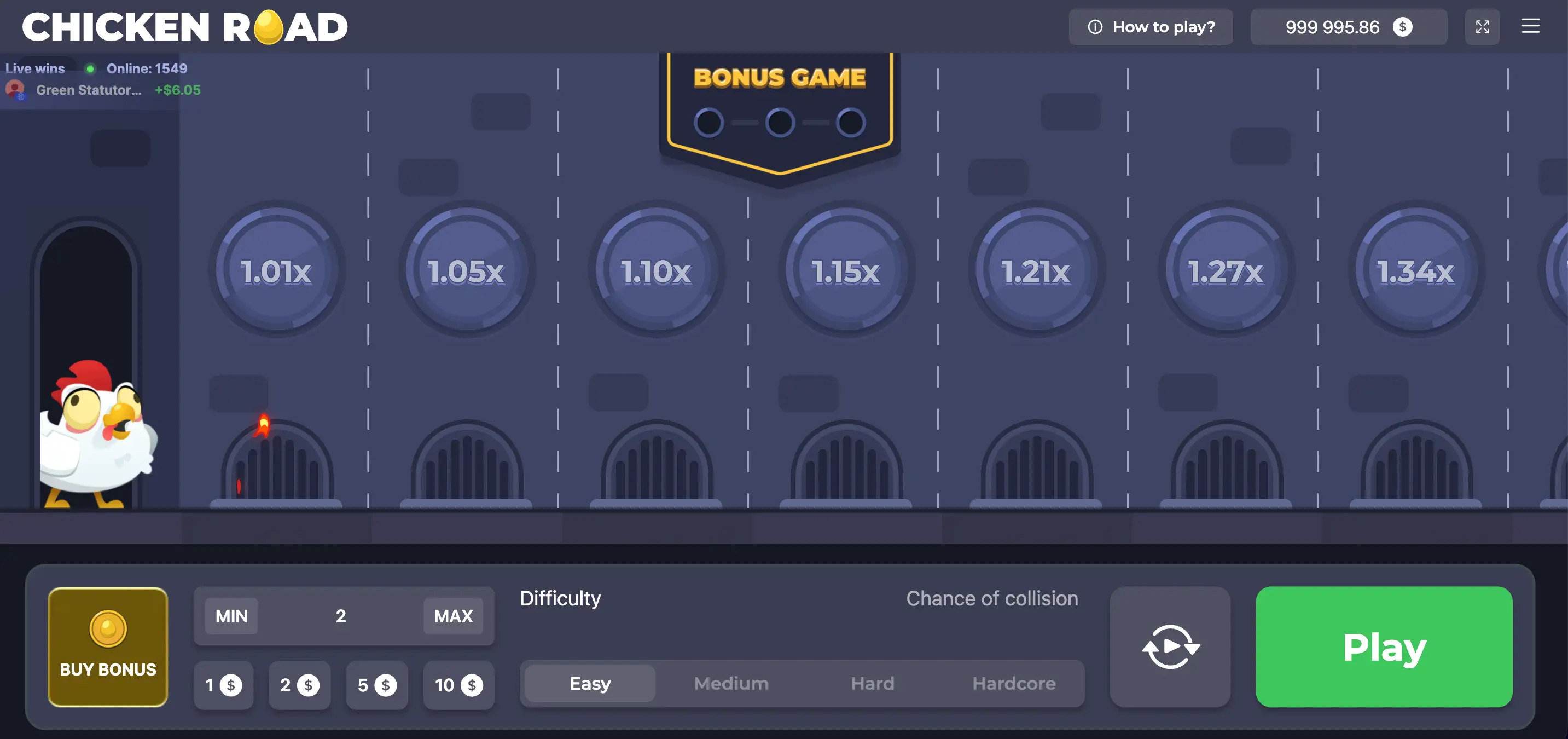
The game generates a grid of tiles. Some tiles are safe, others contain fire. The Provably Fair system determines tile positions using server and client seeds plus a nonce—verifiable after each round.
Click "Go" to advance one tile forward, increasing your multiplier. Alternatively, click "Cash Out" to secure your current winnings and end the round.
If you step on a safe tile, your multiplier increases and you can continue. If you hit a fire tile, the round ends immediately and all current winnings are lost. There is no pattern to predict outcomes.
Each difficulty mode in Chicken Road dramatically changes the game's risk profile, RTP, and maximum potential payout. Understanding these differences is critical for managing your session bankroll effectively.
| Difficulty | Total Tiles | Starting Multiplier | Max Multiplier | RTP | Best For |
|---|---|---|---|---|---|
| Easy | 24 | x1.02 | x24.5 | 96% | Long sessions, low variance |
| Medium | 22 | x1.11 | x2,254 | 88% | Balanced risk-reward |
| Hard | 20 | x1.22 | x52,067 | 80% | High-risk players |
| Hardcore | 15 | x1.63 | x3,203,384 | 60% | Extreme volatility seekers |
Critical Warning: The RTP on Hardcore difficulty is only 60%, meaning over time you will lose 40% of all money wagered. This mode is designed for entertainment, not profit. Only use it with strict loss limits and money you can afford to lose entirely.
Your final payout in the bonus is your triggering bet multiplied by the final multiplier. Understanding the forces that shape this multiplier is crucial for setting realistic expectations.
There is no strategy that can overcome the house edge. However, you can manage your session to avoid rapid, catastrophic losses. Think of it as a "damage control" framework:
Decide on your total session budget before you start. A sensible allocation is 1-2% of your total gambling budget for a single Chicken Road session. For example, if you have $1,000 total, allocate $10-$20 maximum per session.
Choose a realistic multiplier target (e.g., 5x or 10x your bet) and commit to cashing out when you reach it. Do not move the goal mid-round—this is how most players lose winnings back to the house.
Higher difficulties offer bigger multipliers but significantly worse RTP. Build experience and extend session time by starting on Easy (96% RTP) or Medium (88% RTP) before attempting Hard or Hardcore modes.
If you crash at a low multiplier, do not increase your bet to "recover" losses. This spiral is the fastest path to losing your entire bankroll. Stick to your pre-defined bet size throughout the session.
Set a timer for your session (e.g., 15-30 minutes) and stop when time expires or when you hit your loss limit, whichever comes first. High-volatility games distort time perception.
Players often lose money in this bonus not because of bad luck, but because of predictable behavioral errors.
Chicken Road belongs to the "crash-style" game category but differs significantly from pure multiplier crash games like Aviator. Understanding these differences helps you manage expectations and choose the right game for your risk profile.
| Feature | Chicken Road | Aviator |
|---|---|---|
| Gameplay Style | Step-based tile navigation | Automatic multiplier climb |
| Player Control | Manual "Go" button for each step | Only cash-out timing |
| Round Duration | 15-30 seconds (player-dependent) | 10-20 seconds (automated) |
| Difficulty Options | 4 levels with different RTPs | Single fixed RTP |
| Visual Feedback | Arcade-style collision/survival | Clean numeric interface |
| Best For | Players who want manual control | Players who prefer automated pacing |
Chicken Road uses a Provably Fair algorithm to generate each round. This means you can verify that the game did not manipulate results after you placed your bet.
Before each round starts, the server generates a server seed (hashed) and you can provide a client seed. These two seeds combine to determine tile positions.
Each round increments a nonce (number used once), ensuring every round is unique even with the same seed pair.
After the round ends, you can access the fairness tab to see the unhashed server seed and verify that the outcome was predetermined before your actions.
Important: Provably Fair does NOT change the house edge or RTP. It only guarantees that the casino cannot cheat on individual rounds. The game is still statistically designed for the house to profit long-term.
Chicken Road is a high-volatility game. This means you can lose your money very quickly. It is essential to play responsibly.
18+ only. Gambling involves risk of financial loss. Only gamble with money you can afford to lose. Never chase your losses. Set deposit, loss, and session time limits before you start playing. If you feel you may have a gambling problem, seek help from organizations like GamCare or Gambling Therapy.
| Total Gambling Budget | Max Session Budget | Recommended Bet Size | Max Rounds Before Stop |
|---|---|---|---|
| $100 | $1-2 | $0.10-$0.20 | 10-20 rounds |
| $500 | $5-10 | $0.25-$0.50 | 20-40 rounds |
| $1,000 | $10-20 | $0.50-$1.00 | 20-40 rounds |
| $5,000+ | $50-100 | $2.00-$5.00 | 20-50 rounds |
No. The outcome of every tile in the battle is determined by a Random Number Generator (RNG), making each round a game of pure chance. There is no skill or pattern that can be used to predict the outcome. All casino games, including Chicken Road, have a built-in house edge, meaning the expected value for the player is negative over time
There is no "good" target that changes the game's math. However, a realistic and disciplined target is 5x or 10x your initial trigger bet. This helps you lock in a win and avoid the common trap of getting greedy and crashing at a high multiplier. Your target should be based on your personal risk tolerance and bankroll, not a desire to "beat the game."
No, it is not. Chicken Road is a form of entertainment with a high risk of financial loss. The game is designed for the casino to have a long-term profit. The high multipliers are possible but statistically rare. You should only play with money you have allocated for entertainment and are prepared to lose in full.
Beginners should start with Easy mode (96% RTP, 24 tiles) to learn the game mechanics and extend session time. The lower volatility and higher RTP make it the most suitable for understanding how the bonus round works before attempting higher-risk difficulties.
The Provably Fair system uses a combination of server seed, client seed, and nonce to generate tile positions before each round. After the round ends, you can verify the unhashed server seed to confirm the outcome was predetermined and not manipulated after your bet. Access the fairness verification section in the game interface to check seeds and hashes.
No. Betting systems like Martingale or pattern-based strategies do not work in Chicken Road because each tile outcome is independent and random. The house edge remains constant regardless of bet size or timing. Structured bankroll management is the only proven way to extend session time, not overcome the mathematical advantage held by the casino.
The maximum multiplier depends on difficulty: Easy (x24.5), Medium (x2,254), Hard (x52,067), and Hardcore (x3,203,384). However, reaching these maximum multipliers requires surviving all tiles in the round, which has an extremely low probability. Most sessions end well below these theoretical maximums.
Switching difficulties mid-session can disrupt your bankroll management plan. It's better to choose one difficulty level at the start and stick with it for the entire session. If you want to try different volatility levels, do so in separate sessions with independent budgets to maintain consistent risk control.