

Chicken vs Zombies isn't your typical slot or table game—it's a high-stakes, real-time "battle" game where survival equals reward. The longer your chicken survives the zombie horde, the higher your multiplier climbs. But make no mistake: this is a high-volatility, rapid-loss environment disguised as lighthearted entertainment. In this guide, we break down exactly how the battle mechanics work, why most players lose quickly, and how to approach the game with full awareness of its risks and structure.
At its core, Chicken vs Zombies is a crash-style multiplier game built on randomness and timing. You place a bet to start a round. A chicken appears on screen, and zombies begin approaching. A multiplier starts at 1.00x and increases continuously. You can cash out at any moment to lock in your winnings (bet × current multiplier). If you wait too long and the zombies catch the chicken, you lose your entire stake.
This "battle" format is purely visual theater—the underlying engine is a random number generator (RNG) that determines the crash point before the round even begins. Every round is independent, and the outcome is fixed at launch. The animation is just a narrative wrapper.
| Game Element | Function | Player Control | Impact on Outcome |
|---|---|---|---|
| Starting Multiplier | Begins at 1.00x every round | None | Baseline for all payouts |
| Multiplier Growth | Increases continuously until crash | None—pre-determined by RNG | Defines maximum possible win |
| Cash-Out Button | Locks in current multiplier × stake | Full control over timing | Only affects whether you win or lose—not crash point |
| Crash Point | Pre-set moment when round ends | None—fixed before round starts | Determines all losses and maximum wins |
| Auto Cash-Out | Automatic exit at preset multiplier | Optional—set before round | Removes emotional timing errors |
There is no skill involved. No strategy changes the odds. The house edge is embedded in the game's return-to-player (RTP) model—typically between 94% and 97% for most crash-style games, meaning a 3–6% expected loss over time. Chicken vs Zombies features a competitive 95.5% RTP, placing it in the middle of this range
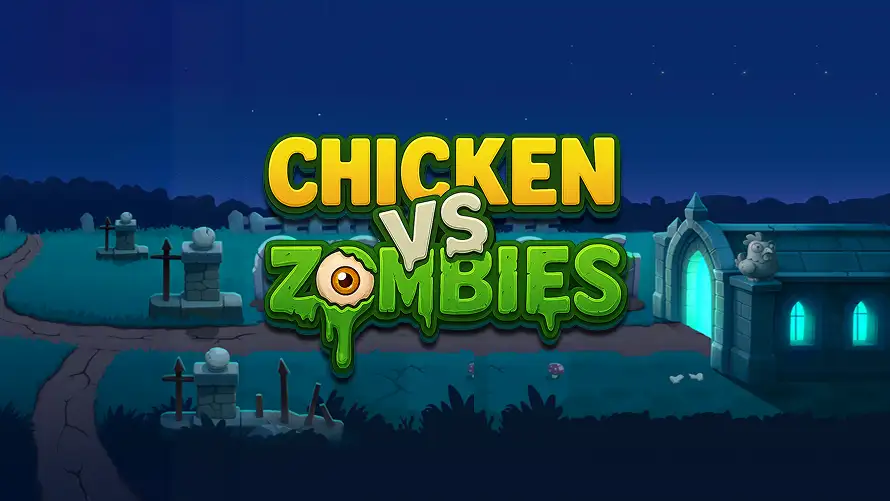
Unlike traditional crash games with a single format, Chicken vs Zombies offers four distinct difficulty levels that alter both total zombie count and risk-reward dynamics. Each mode changes how quickly multipliers compound and how many "lives" (zombie encounters) you have before elimination.
| Mode | Total Zombies | Risk Level | Multiplier Progression | Recommended For |
|---|---|---|---|---|
| EASY | 30 Zombies | Lower Risk | Gradual gains, smaller increments | New players, conservative bankroll management |
| MEDIUM | 25 Zombies | Moderate Risk | Balanced progression | Experienced players seeking moderate volatility |
| HARD | 22 Zombies | High Risk | Faster compounding, higher peaks | Risk-tolerant players with strict limits |
| HARDCORE | 18 Zombies | Maximum Risk | Exponential growth, frequent early crashes | High-stakes players only—not recommended for beginners |
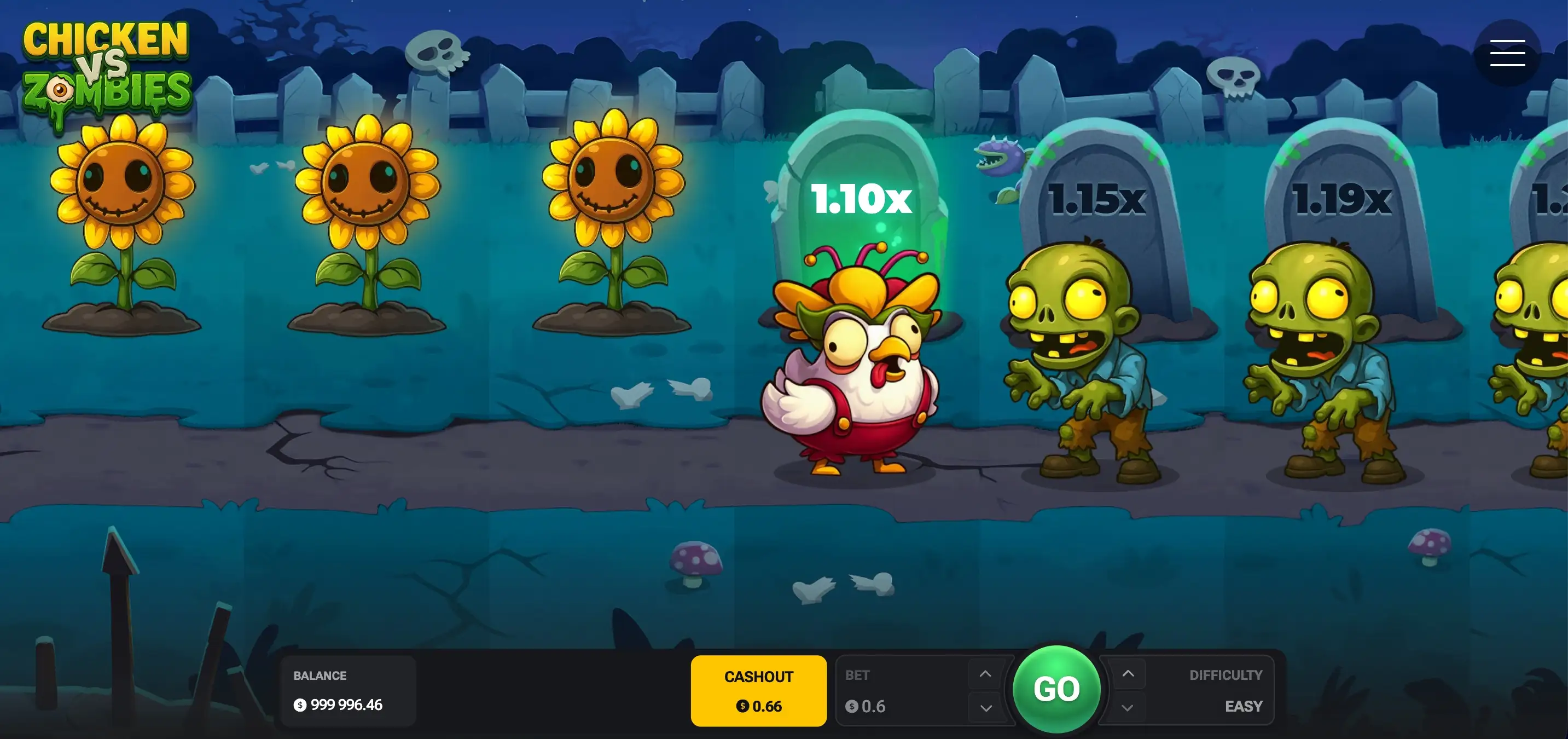
Each zombie defeated unlocks a new tombstone with an increasing multiplier: 1.01x, 1.03x, 1.06x, 1.10x, 1.15x and beyond. In Hardcore mode, these gains compound faster but with fewer safety margins—one miscalculation ends the round
The biggest trap in Chicken vs Zombies is the illusion of control. The visual tension—zombies closing in, the chicken dodging—triggers emotional decisions. Players think, "Just a little longer," and wait past safe exit points. This is not strategy; it's self-sabotage fueled by excitement.
Consider this realistic scenario:
Repeat this 10 times, and you've lost $100 chasing $30 in extra profit that never materialized. This is classic high-volatility behavior: small, frequent losses punctuated by rare big wins that rarely offset the bleed
Key risk factors:
There is no winning strategy for Chicken vs Zombies—only damage control. The goal isn't to "beat" the game but to engage with eyes open and limits in place.
Decide your maximum total loss for the session (e.g., $50 max) and stop immediately when reached. Never reload funds mid-session.
Select a realistic multiplier range (e.g., 1.8x–2.2x) and commit to exiting within that window every round. Avoid "just one more zombie" thinking.3
Enable automatic exit at your preset multiplier. This removes emotional decision-making and prevents last-second hesitation that causes losses.
Maintain a simple log: bet amount, cash-out point (or crash point if lost), result. Review after every 10 rounds to identify emotional patterns.
No chasing losses. If you hit your $50 limit, close the game immediately. Take a 24-hour break before next session.
Start with Easy mode on small stakes. Only advance to Medium/Hard after demonstrating consistent discipline across 50+ rounds. Avoid Hardcore unless you can afford complete session loss.
This isn't about maximizing profit—it's about minimizing surprise losses. Even with auto-cashout at 2x, you'll still lose roughly 40–50% of rounds due to early crashes. That's the math, not bad luck
Some players confuse Chicken vs Zombies with "bonus hunting"—a session format where you trigger and save bonus rounds across multiple slots to play them later in a batch. These are fundamentally different:
| Aspect | Chicken vs Zombies | Bonus Hunting |
|---|---|---|
| Game Type | Crash-style multiplier | Slot bonus features (free spins, picks) |
| RNG Role | Determines single crash point per round | Determines bonus trigger + feature outcome |
| Player Control | Only cash-out timing (no effect on outcome) | None—RNG decides everything |
| Risk Profile | High-speed, total-loss per round | Slower, bankroll-draining over spins |
| Session Duration | Seconds per round, 50+ rounds per 15 minutes | Minutes to hours collecting features, then batch play |
| Typical RTP | 95.5% (Chicken vs Zombies) | 94–97% depending on slot |
Both formats carry negative expected value (EV)—you're expected to lose over time. Neither offers a path to consistent profit. The only "edge" is self-discipline.
Chicken vs Zombies uses SHA256 server seed hashing combined with client seeds to ensure outcome transparency. This "provably fair" technology allows players to independently verify that each round's crash point was determined fairly before the round began—not manipulated in real-time.
Before you place your bet, the game server creates a cryptographic hash (SHA256) of the predetermined crash point. This hash is displayed to you but cannot be reversed to reveal the actual crash point.
Your device contributes a client seed (random value) that combines with the server seed. This ensures neither party can manipulate the outcome alone.
The multiplier rises and crashes at the pre-determined point. You cash out (win) or fail to cash out (lose) based on your timing relative to this fixed crash point.
After the round, the server reveals the original seed. You can use independent verification tools to confirm the hash matches and the crash point was not altered. This proves fairness
While provably fair systems guarantee random, unmanipulated outcomes, they do not change the house edge. The 95.5% RTP remains constant—meaning over thousands of rounds, players collectively lose 4.5% of total wagers. Fairness ≠ profitability.
Chicken vs Zombies' fast pace and emotional visuals make it especially risky for impulsive players. Use these tools:
Never play with money you can't afford to lose. Never chase losses. Remember: the game is designed to entertain—not to pay out.
The game's interface leverages a navy blue night sky gradient paired with teal-cyan fog effects, creating atmospheric tension without overwhelming the player. Gray-blue tombstones display multipliers in inactive state, then glow bright green when conquered. When zombies fall, cheerful sunflowers sprout from the graveyard soil, marking your progress and showing how many undead you've defeated
The bottom control panel spans full width with semi-transparent dark overlay. Your balance displays on the far left, bet controls in the center with increment/decrement arrows, and the lime green circular play button dominates center position. Once active, it switches to "GO" text for continuing your zombie battle streak.
The cashout button transforms from inactive gray dash to glowing orange-yellow showing exact winning amount during gameplay. This real-time update builds tension as you watch numbers climb while deciding between greed and security. This visual feedback loop is intentionally designed to trigger emotional decision-making—not to help you win.
No—if it's offered by a licensed operator using certified RNGs, outcomes are random and fair. Chicken vs Zombies uses SHA256 provably fair technology, allowing independent verification of each round. However, "fair" doesn't mean "profitable." The 95.5% RTP ensures long-term losses for players.
No. Every round is independent and predetermined by RNG before it starts. No system—martingale, timing patterns, or "hot/cold" tracking—can overcome the built-in house edge. The only effective strategy is strict bankroll management and fixed cash-out targets
There's no universal "best." Lower multipliers (1.5x–2.5x) win more often but yield smaller returns. Higher targets (5x+) rarely hit and increase total loss rate. Choose based on your risk tolerance and session budget—not perceived "hot streaks." Use auto-cashout at your chosen level to avoid emotional errors.
No. Its speed and emotional triggers make it particularly dangerous for new players. The visual tension (zombies closing in, glowing tombstones) encourages impulsive decisions that drain bankrolls quickly. Start with slower, transparent games (e.g., European roulette or blackjack with basic strategy) to understand bankroll management first.
Difficulty modes alter total zombie count and multiplier progression speed. Easy (30 zombies) offers gradual gains with lower risk. Hardcore (18 zombies) features exponential growth but frequent early crashes. Higher difficulty does not improve RTP—only changes volatility profile. Match mode to your bankroll, not your emotions.
Auto-cashout allows you to preset a target multiplier (e.g., 2.0x) before the round begins. When the multiplier reaches that level, the game automatically cashes out your winnings—removing the temptation to wait "just one more second." This feature eliminates emotional decision-making and is strongly recommended for all players.
Yes. After each round, the server reveals the original seed used to generate the crash point. You can use independent SHA256 verification tools to confirm the hash matches and the outcome was predetermined—not manipulated mid-round. This provably fair system ensures transparency, though it doesn't change the 4.5% house edge.
If you lose connection during an active round, the outcome is already determined by the pre-set crash point. If you had auto-cashout enabled and the multiplier reached your target before the crash, your winnings are credited. Without auto-cashout, the round continues without you—and you lose if the crash occurs before reconnection. Always use auto-cashout to protect against disconnections.